Investor Education
How Industrial Real Estate Actually Makes Money: Rent, NOI, Cap Rates, Debt and Property Value Explained
Published September 7, 2026 · 16 min read
For investors researching an industrial real estate investment in Canada, one of the most useful things to learn is how the property actually produces an economic return.
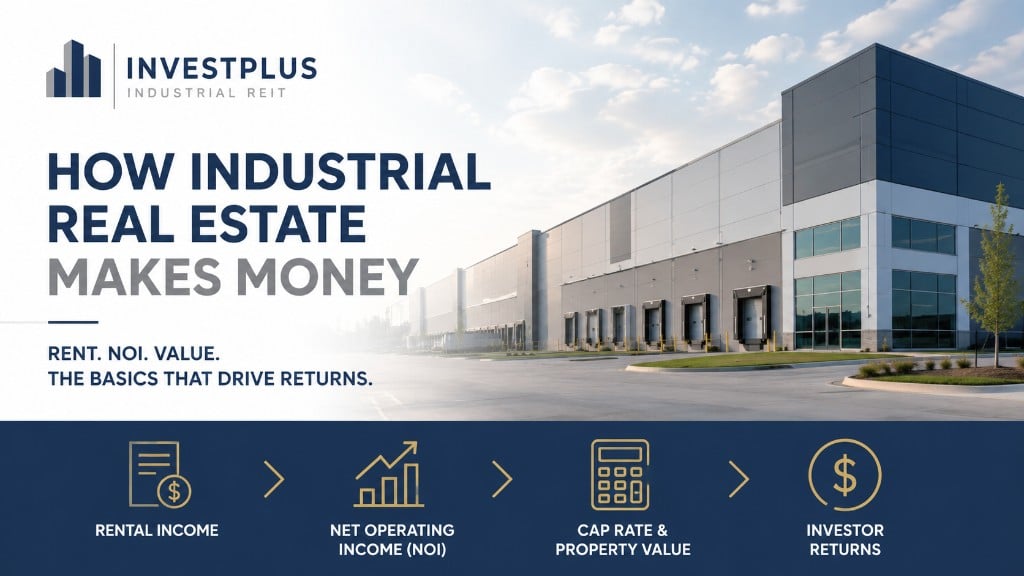
Industrial real estate does not make money simply because a warehouse exists or because property values rise.
At the property level, performance generally comes from a combination of rental income, operating expenses, changes in net operating income, the price investors are willing to pay for that income, financing costs and capital invested back into the building.
For investors in a private industrial REIT, there is another layer. The return received by a REIT investor is not the same thing as the rent collected by the properties or the capitalization rate quoted when a property is purchased.
Understanding those differences makes it easier to evaluate an industrial real estate opportunity on its fundamentals rather than a headline return number.
The Basic Economics of an Industrial Property
At its simplest, an industrial building is an operating asset.
A tenant pays rent for the right to use space. The property owner uses part of that income to pay expenses associated with owning and operating the building. What remains contributes to net operating income.
From there, the owner may still need to pay:
- Mortgage interest
- Loan principal
- Capital expenditures
- Leasing commissions
- Tenant improvements
- Corporate or fund expenses
- Management costs
- Other costs that are not included in property-level operating expenses
This is why gross rental revenue tells investors very little by itself.
A property collecting $1 million per year in rent is not necessarily more profitable than a property collecting $800,000. The expenses, debt, leases and capital requirements matter — which is the same reason the building, not the marketing headline, is the real starting point.
Start with the assets: Review how InvestPlus Industrial REIT’s Western Canada industrial portfolio is built, then compare that with the questions in what to ask before investing $100,000.
1. Rental Income: Where Property Revenue Starts
Rent is the most visible source of income in commercial real estate.
Industrial tenants typically enter into leases that specify how much they pay, how long they occupy the property, how rent may change and which property expenses they are responsible for.
Commercial leases can be structured in several ways. In many industrial properties, tenants pay base rent plus some or all of the property’s operating costs. Those additional costs may include property taxes, insurance, common-area expenses and certain maintenance costs.
Lease structures vary, so investors should never assume that all operating expenses can automatically be passed through to tenants. The lease document controls.
This makes lease quality a major part of industrial real estate analysis. An investor should look at:
- Current rental rates
- Remaining lease terms
- Scheduled rent increases
- Tenant renewal options
- Expiring leases
- Market rental rates
- Tenant financial strength
- Expense recovery provisions
A building may be fully occupied today but face several major lease expirations next year. Another building may have slightly lower occupancy but long lease terms with gradual contractual rent increases.
Occupancy alone does not tell the full story — one of the common mistakes in industrial real estate investing.
Contractual Rent Growth Can Increase Income
Some industrial leases include scheduled rent increases. For example, a tenant may agree to pay $12 per square foot during the first portion of a lease and a higher amount in later years.
If expenses remain reasonably controlled, higher rent can increase net operating income.
There can also be an opportunity when an older lease expires and the current market rent is higher than the rent being paid by the existing tenant. This is sometimes referred to as mark-to-market potential.
It can work in the other direction too. If market rents fall, replacing a tenant may require the owner to accept lower rent, provide incentives or leave the space vacant longer.
Rent growth should never be treated as automatic.
2. Operating Expenses: Revenue Is Not Profit
Industrial properties cost money to operate. Common expenses may include:
- Property taxes
- Insurance
- Repairs
- Property management
- Snow removal
- Landscaping
- Utilities paid by the landlord
- Building maintenance
- Common-area costs
Some expenses may be recoverable from tenants under their leases. Others remain the responsibility of the owner. This distinction has a direct effect on property profitability.
Inflation can also affect expenses. Insurance premiums can rise. Property taxes can change. Labour and repair costs can increase.
If rental revenue increases by 3% but expenses rise by 7%, the benefit to the property owner may be smaller than the increase in rent suggests.
This brings us to one of the most important numbers in commercial real estate.
3. Net Operating Income: The Number Investors Should Understand
Net operating income, commonly called NOI, measures income produced by the property after normal property operating expenses.
A simplified formula is:
NOI = Property revenue − property operating expenses
That $700,000 is a much more useful measure of the building’s operating economics than the $1 million of gross revenue.
But NOI is not the same as cash available to investors. NOI is normally calculated before financing costs, income taxes, depreciation and certain capital expenditures.
This distinction matters. A property could produce healthy NOI and still have limited free cash flow because it carries substantial debt or requires significant capital investment.
What Can Increase NOI?
An industrial property owner may try to increase NOI in several ways. Potential strategies include:
- Leasing vacant space
- Increasing rents when leases renew
- Adding contractual rent increases
- Reducing avoidable operating costs
- Improving expense recoveries
- Dividing large spaces into smaller rentable units
- Improving underused areas
- Replacing non-paying tenants
- Acquiring properties with below-market rents and gradually resetting leases
None of these outcomes is guaranteed. Vacant units can take longer than expected to lease. Renovations can cost more than planned. Existing tenants may leave rather than accept higher rents.
Active property management therefore plays a meaningful role in real estate performance — including whether a portfolio is mostly small-bay or large-bay industrial.
See How InvestPlus Looks at Industrial Assets
The Investor Overview explains how InvestPlus Industrial REIT evaluates Western Canada industrial properties, tenants, lease structures and market fundamentals — before you look at any offering documents.
Access the Investor Overview4. Cap Rates: Turning Income Into Property Value
The capitalization rate, or cap rate, is one of the most commonly quoted figures in commercial real estate.
A simplified formula is:
Cap Rate = Annual NOI ÷ Property Value
The formula can also be rearranged: Property Value = NOI ÷ Cap Rate.
Suppose a property produces $600,000 of annual NOI. At a 6% cap rate:
$600,000 ÷ 0.06 = $10,000,000
Based purely on that simplified calculation, the property would be valued at approximately $10 million. This example leaves out many details involved in an actual appraisal or transaction, but it shows why cap rates matter.
CBRE describes commercial real estate value as being influenced by current NOI, expected future NOI and the capitalization rate investors apply to those earnings.
Lower Cap Rate, Higher Implied Value
If the same $600,000 NOI is valued at different cap rates, the implied property value changes even though the building’s current income does not.
$600,000 ÷ 0.055 ≈ $10.91 million implied value.
$600,000 ÷ 0.065 ≈ $9.23 million implied value.
Nothing about the property’s current NOI changed. The valuation changed because the market’s required return changed.
This is one of the most important concepts for real estate investors to understand.
A property can become more valuable because NOI rises. It can also become more valuable because market cap rates fall. The reverse is equally true. If cap rates rise, property values can decline even if rent and NOI remain stable.
What Causes Cap Rates to Change?
Cap rates reflect many factors, including:
- Interest rates
- Financing availability
- Investor demand
- Property quality
- Location
- Tenant credit quality
- Lease length
- Expected rental growth
- Economic conditions
- Perceived risk
- Supply and demand for investment properties
Cap rates also differ substantially between markets and properties. A modern industrial facility leased for 15 years to a financially strong national tenant may trade at a different cap rate than an older multi-tenant building with several near-term lease expirations.
There is no single “Canadian industrial cap rate.”
What Are Canadian Cap Rates Doing in 2026?
Commercial real estate pricing has been adapting to a changing interest-rate environment.
CBRE reported that Canada’s average cap rate across all major property categories was 6.58% in Q2 2026, down slightly from 6.61% in the previous quarter. Industrial cap rates also compressed modestly during the quarter.
Those figures describe broad market trends. They should not be used to estimate the value of an individual industrial building without examining its location, condition, tenant profile, lease structure and comparable transactions.
CBRE expects high-quality and resilient assets, including some small-bay industrial properties, to have greater potential for cap-rate compression than parts of the broader commercial real estate market during 2026.
Again, that is a market outlook rather than a promise of future valuation growth.
Markets are local: National averages can hide the difference between a tight Western Canada industrial submarket and a building with near-term lease risk. That is why seeing the building still matters.
5. Debt: How Financing Can Amplify Gains and Losses
Most commercial real estate purchases involve some form of financing.
Consider a simplified $10 million property acquisition. Instead of paying the entire purchase price in cash, an investor might contribute $4 million of equity and borrow $6 million. This is leverage.
Debt allows an investor to control a larger asset with less equity. That can increase the return earned on invested equity when the property performs well. It can also increase losses when the property performs poorly.
Suppose the $10 million property rises in value to $11 million. Ignoring transaction costs and loan changes, the property gained 10%. But the investor originally contributed only $4 million of equity. That $1 million increase represents 25% of the original equity contribution. Leverage amplified the gain.
Now reverse the example. If the property’s value falls from $10 million to $9 million, the property declined 10%. But that $1 million decline represents 25% of the original $4 million equity contribution. Leverage also amplified the loss.
Debt should never be treated simply as a tool for increasing returns. It changes the investment’s risk.
Interest Rates Matter Too
Debt has a cost. Commercial borrowers pay interest, and financing terms may change when loans mature.
As of July 15, 2026, the Bank of Canada’s target overnight rate was 2.25%. The prime rate posted by Canada’s major chartered banks was 4.45% as of August 5, 2026.
Commercial real estate loans do not simply use either of those rates. The interest rate offered on an industrial mortgage depends on factors such as the lender, loan term, property, borrower, leverage, debt coverage, amortization and market conditions.
Still, changes in the broader interest-rate environment influence the cost and availability of commercial real estate financing. Higher borrowing costs can reduce property cash flow. They can also affect what buyers are willing to pay for properties.
Refinancing Risk Is Easy to Overlook
A commercial property can have a strong tenant base and still face financial pressure when its mortgage matures.
Imagine a property financed several years ago at a relatively low interest rate. If the loan must be refinanced at a higher rate, annual interest expense may rise. The property’s NOI might remain unchanged while the cash available after financing falls.
Investors evaluating a private REIT should therefore look at more than total debt. Ask:
- When does the debt mature?
- What interest rates are currently being paid?
- Are rates fixed or variable?
- How much debt is secured against the portfolio?
- Does a large percentage of the debt mature during the same period?
- How comfortably does property income cover financing obligations?
Debt maturity schedules can matter almost as much as the amount borrowed.
Prefer a Conversation Over a Spreadsheet?
If you are researching private industrial real estate, book a discovery call with Investor Relations. Bring questions about tenants, leases, debt and how the portfolio is constructed.
Book a Discovery Call6. Capital Expenditures: Buildings Require Reinvestment
NOI does not capture every dollar required to maintain a property over the long term.
Industrial buildings may eventually require:
- Roof replacement
- HVAC replacement
- Paving
- Structural repairs
- Loading-door replacement
- Electrical upgrades
- Fire-system upgrades
- Environmental work
- Tenant improvements
These expenses can be substantial. That is why investors should be cautious about comparing properties based only on cap rate.
A property acquired at an apparently attractive cap rate may require millions of dollars of repairs shortly after purchase. Another property purchased at a lower initial yield may require little near-term capital.
The acquisition price alone does not reveal the complete economics.
7. Leasing Costs Can Affect Cash Flow
When industrial space becomes vacant, the landlord may need to spend money before a replacement tenant begins paying rent. Potential costs include:
- Brokerage commissions
- Tenant improvements
- Renovations
- Free-rent periods
- Legal costs
- Marketing
- Utilities during vacancy
There may also be months with no rent coming from the space. This is called downtime.
Smaller industrial bays can sometimes have a larger pool of potential occupants than very large facilities. CBRE’s 2026 Canadian industrial outlook specifically identifies small- and mid-bay properties as having greater leasing flexibility under current market conditions.
That does not remove vacancy risk. It simply affects the size of the potential tenant pool — another reason to understand how bay size changes tenant depth.
A Simple Industrial Property Example
Consider a hypothetical industrial building generating:
- Gross annual property revenue: $1,200,000
- Operating expenses: $350,000
That produces NOI of $850,000.
Suppose the property has annual interest and scheduled financing payments of $400,000. That leaves $450,000 before other fund-level expenses, capital expenditures and taxes.
Now imagine the owner spends $150,000 replacing part of the roof and $75,000 preparing a vacant unit for a new tenant. Cash remaining for that year falls again.
Statements such as “the building generates $1.2 million in rent” provide very limited information.
Investors need to understand what happens between gross rent and the cash that may ultimately become available for distribution.
How Property Value Can Grow
Industrial real estate value can potentially increase through several mechanisms.
Increasing NOI
If the owner increases occupied space, raises rent or controls costs, NOI may increase. If market cap rates stay similar, higher NOI can support a higher property valuation.
Cap-Rate Compression
If investors become willing to accept a lower yield for the property, the property’s valuation may rise even without an increase in NOI. This can reverse quickly when market conditions change.
Property Improvements
Renovations, building upgrades or improved functionality may make a property easier to lease or allow it to support higher rent. The cost of those improvements needs to be considered against the benefit.
Market Growth
Population growth, business investment, limited industrial land and infrastructure development can affect tenant demand. These forces vary substantially by market — including why some investors keep returning to industrial real estate as an operating asset class.
Income-Producing Real Estate Does Not Mean Fixed Income
This distinction is particularly important for investors comparing private REITs with bonds, GICs or other income investments.
Industrial real estate may generate rental income. That does not make a REIT unit equivalent to a fixed-income security.
- Property income can change.
- Tenants can leave.
- Expenses can increase.
- Interest costs can rise.
- Property values can decline.
- Distributions can be reduced or suspended.
- Private REIT units can also have limited liquidity.
InvestPlus Industrial REIT’s own disclosure states that its REIT units are not comparable to fixed-income securities, that invested capital is at risk and that distributions may be reduced or suspended.
Those are important distinctions for any prospective investor to understand.
A REIT’s Distribution Is Not the Same as Its Return
Investors sometimes use the words “distribution,” “yield” and “return” as if they mean the same thing. They do not.
- A distribution is an amount paid to an investor.
- A distribution yield generally compares annual distributions with the value or purchase price of the investment.
- A total return considers distributions plus or minus changes in the value of the investment.
- A property cap rate describes the relationship between property-level NOI and property value.
These are different calculations.
A REIT reporting a target investor return of a certain percentage is not saying that every building in the portfolio was purchased at that cap rate. Investors should understand exactly what number is being presented before comparing investment opportunities.
Review the Current Offering Documents
A marketing page can help you understand the basic strategy. It should not replace the legal and financial documents. Review the current Offering Memorandum before making any investment decision.
Review the Current OfferingWhat Should You Review Before Investing?
If you are evaluating an industrial REIT in Canada, ask for information that helps connect the investor-level opportunity with the underlying properties.
Review:
- Portfolio NOI
- Occupancy
- Rental rates
- Lease expirations
- Tenant concentration
- Debt levels
- Interest rates
- Debt maturity dates
- Property valuations
- Capital expenditure requirements
- Acquisition prices
- Management fees
- Fund expenses
- Distribution policy
- Redemption terms
- Historical financial statements
For a private investment, the Offering Memorandum should be part of that review. A marketing page can help you understand the basic strategy. It should not replace the legal and financial documents.
How This Applies to InvestPlus Industrial REIT
InvestPlus Industrial REIT focuses on industrial real estate across Western Canada.
Its published portfolio currently reports approximately $118 million in assets under management, 750,000 square feet of space and 20 buildings across Alberta and Saskatchewan.
Those properties produce the underlying real estate economics behind the REIT. For a prospective investor, the useful questions are not limited to how large the portfolio is. You should also understand:
- What types of properties are owned?
- Who occupies them?
- When do major leases expire?
- How is debt structured?
- What capital improvements are planned?
- How are properties valued?
- How are distributions funded?
- What fees are charged at the REIT level?
- What happens if you eventually want to redeem your units?
Those questions help turn an investment presentation into an actual investment analysis.
Frequently Asked Questions
What is NOI in industrial real estate?
Net operating income is property revenue minus ordinary property operating expenses. It is commonly used to measure the operating performance of commercial real estate before financing costs, taxes, depreciation and certain capital expenditures.
What is a good cap rate for industrial property?
There is no universal “good” cap rate. A cap rate needs to be evaluated in relation to the property’s location, tenant quality, lease terms, building condition, financing environment and risks. A higher cap rate may indicate a potentially higher property yield, but it can also reflect greater perceived risk.
Does a higher cap rate mean a better investment?
No. A higher cap rate may be associated with a lower purchase price relative to current NOI, but there may be reasons the market demands that higher yield. The tenant may be weaker, leases may be expiring, the building may need work or the location may have less demand.
Can property values fall even when rent stays the same?
Yes. If market cap rates rise, the implied value of the same amount of NOI can decline. Financing conditions, investor demand and changes in perceived risk can all affect valuations.
Does debt increase real estate returns?
Debt can amplify the return on equity when a property performs well. It can also amplify losses and introduce interest-rate and refinancing risks.
Are REIT distributions guaranteed?
No. REIT distributions depend on the financial condition and policies of the trust. For a private REIT, investors should review the current Offering Memorandum. InvestPlus Industrial REIT states that distributions may be reduced or suspended.
Understand the Numbers Before You Look at the Return
Industrial real estate can generate income in a relatively understandable way.
Businesses lease space. The properties generate rental revenue. Expenses are paid. The remaining NOI contributes to the economic value of the property.
But investor returns involve several additional variables. Debt, cap rates, capital expenditures, leasing costs, fees and property valuations can all change the outcome.
That is why understanding the underlying real estate matters. Before evaluating any private industrial REIT, learn how those pieces fit together.
Review the Details, Then Ask Questions
Start with the InvestPlus Industrial REIT Investor Overview. You can also review the Western Canada industrial portfolio and the current Offering Memorandum before speaking with Investor Relations.
Get the Investor OverviewInvestment risk notice: This article is provided for informational and educational purposes only. It does not constitute investment, legal or tax advice, an offer to sell securities or a solicitation to purchase securities. Investing in InvestPlus Industrial REIT units involves risk. The value of an investment may decrease, invested capital is at risk, and past performance may not be repeated. Private REIT units may have limited liquidity and there is currently no secondary market through which InvestPlus Industrial REIT units may be sold. Distributions are not guaranteed and may be reduced or suspended. Prospective investors should review the current Offering Memorandum and related legal materials and speak with an Exempt Market Dealer, tax advisor and other qualified professionals before making an investment decision.
Sources & further reading
- CBRE Canada — Canada Cap Rate Survey / Q2 2026 commercial real estate pricing commentary
- CBRE Canada — 2026 Canadian Industrial Outlook (small- and mid-bay leasing flexibility)
- Bank of Canada — Target overnight rate, July 15, 2026
- Bank of Canada / major chartered banks — Prime rate as of August 5, 2026
- InvestPlus REIT Commercial Portfolio: investplusproperties.com/commercial-portfolio
- InvestPlus REIT Investor Overview: investplusproperties.com/whitepapers/investor-overview-whitepaper
- InvestPlus REIT Current Offering: investplusproperties.com/current-offering