Investor Education
The Investment Isn’t the Secret. The Building Is.
Published July 27, 2026 · 12 min read
Why experienced investors look past returns and study tenants first.
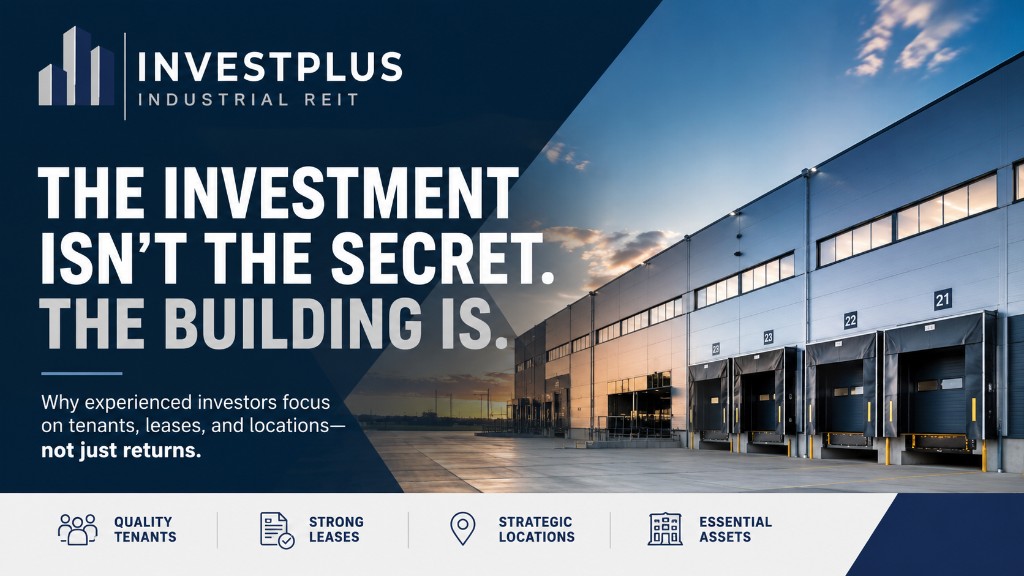
Industrial real estate investment starts with a simple question: what is actually producing the return? For experienced investors, the answer is rarely found in a headline yield, a forecast, or a polished chart. It starts with the building, the tenant, the lease, and the market around it.
“What does it pay?”
“What is creating the income?”
That difference matters.
A return is the outcome. The building is the source.
Before reviewing projected distributions, cash flow models, or appreciation assumptions, experienced investors want to understand the income engine underneath the investment.
In industrial real estate, that engine is simple:
- A tenant occupies a building.
- The tenant pays rent.
- The lease defines the relationship.
- The market determines how valuable that space may be over time.
Everything else comes after that.
A strong return projection means very little if the tenant is weak, the lease is short, the building is hard to re-lease, or the market has too much competing supply. That is one reason investors still focus on seeing the building before trusting the pitch.
Why the Building Matters More Than the Pitch
Many investment products ask investors to trust a future plan.
Industrial real estate lets investors study existing facts.
- The building exists.
- The tenant is known.
- The lease can be reviewed.
- The location can be assessed.
- The local market can be compared against real data.
That visibility is one reason institutional investors continue to pay close attention to industrial real estate. In 2025, Canadian commercial real estate investment volumes reached $47.0 billion, according to CBRE Canada’s Q4 2025 Investment Overview. That capital did not move into real estate because investors like buildings in theory. It moved because real estate can be evaluated through leases, income, replacement cost, tenant demand, and market fundamentals.
Industrial real estate is especially direct.
A warehouse, logistics facility, flex industrial building, or light manufacturing property is tied to real business activity. Companies need space to store inventory, move goods, service customers, support operations, and keep supply chains running.
That does not remove risk. No private real estate investment can do that. But it does give investors something useful: a way to analyze the source of income before making a decision — the same lens behind InvestPlus REIT’s corporate strategy and Western Canada industrial portfolio.
Returns Are an Output, Not the Starting Point
A less experienced investor may compare opportunities by asking which one shows the highest projected return.
A seasoned investor slows down.
They want to know:
- Who is paying the rent?
- Why does that tenant need the space?
- How long is the lease?
- What happens when the lease expires?
- Could the building attract another tenant?
- Is the market tightening or softening?
- Is new supply coming?
- Are rents stable, rising, or falling?
That is the real work.
For example, CBRE reported that Canada’s national industrial availability rate was 5.6% in Q4 2025. Annual net absorption reached 8.7 million sq. ft., up from 2.3 million sq. ft. in 2024, while new supply fell 38.8% year-over-year to its lowest level in five years, according to CBRE’s Canada Industrial Figures Q4 2025.
Those numbers matter because they show the market context around a building.
A tenant in a strong industrial market may have fewer relocation options. A building in a market with limited new supply may hold more strategic value. A lease attached to a tenant with real operational need may carry more weight than a lease attached to a tenant that can leave easily.
The return is only meaningful after those details are understood. Skipping that step is one of the common mistakes in industrial real estate investing.
What Experienced Investors Actually Study
1. Does the Tenant Need This Building?
This is one of the most important questions in industrial real estate.
A tenant using a building as a core distribution hub is different from a tenant using it for overflow storage.
A manufacturer with equipment, staff, permits, customer routes, and loading requirements has a different relationship with the building than a company using temporary space.
Experienced investors look for operational dependency.
They ask:
- Does this building support the tenant’s core business?
- Is it close to customers, highways, suppliers, or labour?
- Has the tenant invested in the space?
- Would moving create cost, downtime, or disruption?
- Is the building part of the tenant’s daily operations?
The more the tenant depends on the facility, the more “sticky” the tenancy may become.
Stickiness does not guarantee renewal. But it can improve the quality of the income profile.
2. How Hard Would It Be for the Tenant to Move?
Industrial relocation is not simple.
A business may need to move:
- Inventory
- Racking
- Machinery
- Fleet operations
- Staff routes
- Shipping systems
- Customer pickup points
- Permits
- Utility connections
- Specialized improvements
That move can create downtime and cost.
Key insight: For many industrial tenants, the building is not just a box. It is part of the operating system — which is why experienced investors care about tenant behaviour as much as rent.
If the tenant has good reason to stay, the building may have stronger income durability.
3. What Happens If the Tenant Leaves?
Good investors never analyze only the best-case scenario.
They ask what happens if the tenant does not renew.
- Can the building be re-leased?
- Would another user want it?
- Is the bay size flexible?
- Is the clear height suitable?
- Are the loading doors useful?
- Is the yard functional?
- Is the location strong?
- Is the local vacancy rate low enough to support demand?
CBRE’s 2026 outlook noted that small and mid-bay industrial properties are expected to outperform large-bay assets because they can offer greater leasing flexibility in an uncertain market. CBRE also forecast national industrial net absorption to rebound to more than 20 million sq. ft. in 2026, closer to pre-pandemic norms, in its Canada Real Estate Market Outlook 2026.
That is the kind of data experienced investors use.
They do not only ask, “What does this pay today?”
They ask, “How resilient is this asset if conditions change?”
Why Western Canada Industrial Real Estate Deserves Attention
Western Canada industrial real estate has its own set of market drivers.
Calgary, for example, has continued to show strength in industrial leasing. Colliers reported that the Greater Calgary Area industrial market recorded 890,874 sq. ft. of positive net absorption in Q4 2025, supported by strong transaction activity and limited new supply. Colliers also noted that large occupiers moved quickly to secure space in key perimeter markets such as Balzac and Carmek, according to its Calgary Industrial Market Report Q4 2025.
That type of activity matters for investors.
It points to real tenant demand. It also reinforces why market selection matters. A building in a supply-constrained industrial node can behave very differently from a building in a weaker market with higher vacancy and less tenant depth — a theme also explored in our look at Calgary’s commercial and industrial landscape.
For private REIT Canada investors, this is where the analysis becomes practical.
The question is not only, “Is industrial real estate attractive?” The better question is: which industrial buildings, in which markets, with which tenants, under which leases?
That is where stronger decisions begin — and how InvestPlus approaches value creation across its assets.
The Lease Is the Income Contract
The lease is where the investment becomes measurable.
Experienced investors review:
- Lease term
- Renewal options
- Rent escalations
- Tenant responsibilities
- Maintenance structure
- Property tax treatment
- Insurance requirements
- Default provisions
- Assignment rights
- Exit clauses
- Capital expense exposure
A long lease with a weak tenant may not be as attractive as it looks.
A shorter lease with a strong tenant in a tight market may deserve a closer look.
A lease with rent growth, clear responsibilities, and strong tenant commitment can support better income visibility.
This is why professional operators do not buy only a building. They buy a building with a lease profile.
The income stream matters. But the structure behind that income matters just as much. Understanding those trade-offs is part of evaluating any private REIT opportunity.
The Best Investors Are Not Chasing Yield
High projected returns can attract attention.
But experienced investors tend to look for something else first: durability.
They want to understand if the property can keep producing income through changing market conditions.
That means reviewing:
- Tenant strength
- Lease quality
- Market vacancy
- Replacement cost
- Location
- Building functionality
- Supply pipeline
- Re-leasing potential
In Q4 2025, CBRE reported that Canada’s national industrial construction pipeline represented only 1.1% of existing inventory. It also reported improving pre-leasing levels on new industrial supply. That matters because new supply can affect vacancy, rent growth, and tenant leverage.
A building does not exist in isolation.
It competes inside a market. The stronger the market and the more useful the building, the more confidence investors may have in the asset’s long-term relevance.
The Real Advantage Is Visibility
The real advantage of industrial real estate is not that it removes risk.
It does not.
The advantage is that the risk can be studied.
- Investors can look at the building.
- They can review the tenant.
- They can study the lease.
- They can compare market data.
- They can ask what happens if the tenant leaves.
- They can assess supply, vacancy, and demand.
That is why sophisticated investors spend less time reacting to return claims and more time reviewing the asset behind the return.
The investment is not the secret. The building is.
And in industrial real estate, a well-located building leased to a tenant with real operational need may tell investors more than any headline return ever could.
Download the Investor Whitepaper
Learn how InvestPlus REIT evaluates industrial properties, tenants, lease structures, and Western Canada market fundamentals before making an acquisition decision.
Download the Investor WhitepaperInvestor note: Private real estate investments involve risk. Distributions are not guaranteed and may be reduced or suspended. Private REIT units may have limited liquidity. Investors should review the offering documents and speak with a qualified advisor before making an investment decision. This article is informational only and does not constitute an offer to sell or a solicitation of an offer to buy securities.
Sources & further reading
- CBRE Canada — Q4 2025 Investment Overview; Canada Industrial Figures Q4 2025; Canada Real Estate Market Outlook 2026
- Colliers — Calgary Industrial Market Report Q4 2025
- InvestPlus REIT Investor Whitepaper: investplusproperties.com/whitepapers/investor-overview-whitepaper
- InvestPlus REIT Commercial Portfolio: investplusproperties.com/commercial-portfolio