
Investor Education
Small-Bay vs. Large-Bay Industrial: What Changes for Your Income
Published September 3, 2026 · Updated September 17, 2026 · 7 min read
Bay size changes two investor outcomes: how many businesses can replace a departing tenant, and how much of your rental income sits with any one occupant. It does not tell you which building is “better.”
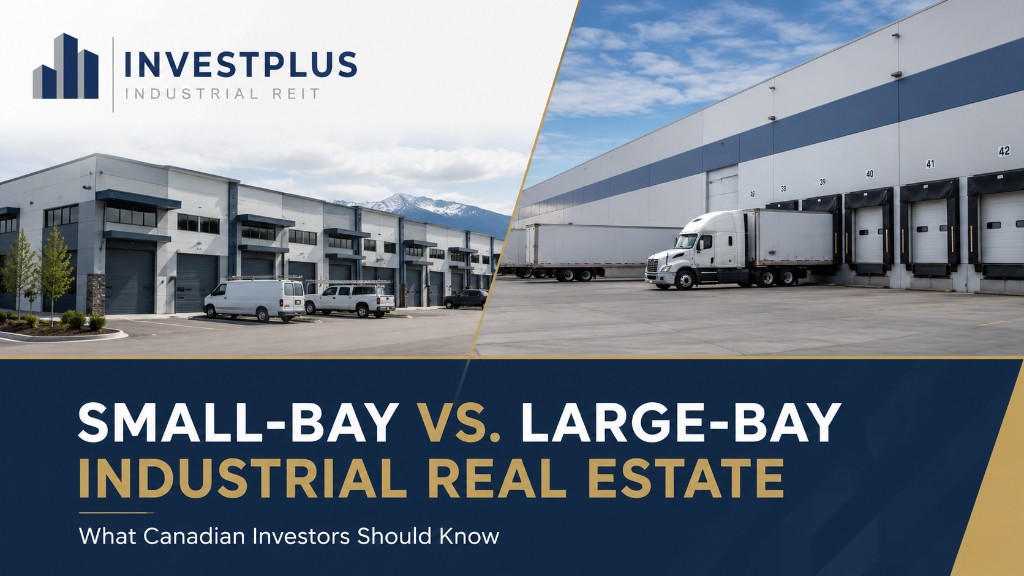
A 7,000-square-foot light-industrial unit and a 400,000-square-foot distribution centre are both “industrial.” Their tenant pools, vacancy impact, and operating load are not the same. Before you evaluate an industrial REIT, you need to know which of those income profiles you own.
What changes for your income
There is no universal Canadian cutoff for small-, medium-, and large-bay. Colliers’ Q2 2026 Calgary industrial analysis used vacant units under 10,000 square feet as small bay, 10,001–40,000 as medium, and greater than 40,001 as large. Other firms use other bands. The investor question is the tenant each band can serve — the same property-level thinking as why the building is the income engine.
If that tenant leaves, the property is fully vacant. Income concentration is 100%.
If one leaves, about 10% of the building is vacant. Income is spread. You also have ten leases to renew.
Neither structure is automatically safer. Occupancy as a headline is not the whole story — one of the common mistakes in industrial real estate investing.
Start with the assets: Review InvestPlus Industrial REIT’s Western Canada commercial portfolio, then what to ask before investing $100,000.
What small-bay exposure can give you
A deeper replacement tenant pool, and the option to spread rent across more businesses.
Typical users: trades, equipment suppliers, fabricators, wholesalers, automotive and service companies, local distributors, other SMEs. A 5,000-square-foot bay can fit many metropolitan businesses. A 500,000-square-foot box needs a company that can occupy and pay for that space.
CBRE’s 2026 Canadian industrial outlook identified small- and mid-bay industrial as a segment expected to outperform larger-bay properties under then-current conditions, citing greater leasing flexibility. In Q2 2026, CBRE reported Calgary industrial availability declined, with the drop especially sharp under 10,000 square feet: available options in that size band were 25.1% lower than a year earlier.
That is tenant-depth evidence. It is not a prediction that small-bay will outperform in every period or at every price.
The cost: more leases, more rollovers, more tenant-improvement and leasing spend. Active management is part of the income story — including how NOI is produced; see what you get paid from.
What large-bay exposure can give you
A smaller tenant list, often with longer contractual rent if the occupant is strong — and a larger hole if they leave.
Large logistics and distribution buildings serve regional distribution, retail, manufacturing, third-party logistics, and e-commerce. A long lease with a financially strong tenant can give years of contractual rent. The trade-off is concentration: fewer replacement tenants who need that size, location, and spec. Vacancy at that scale can dominate one property’s income.
A portfolio that is “95% occupied” can be hundreds of unrelated tenants or a handful of large occupants. Those are not the same economic positions. Seeing the building still matters.
What still has to be true of the building
Square footage does not tell you whether another tenant will pay. Clear height, loading, power, truck access, yard, parking, depth, and proximity to transport decide usefulness. Prologis identified access to power for automation and manufacturing as a major 2026 location consideration for logistics users, and continues to track e-commerce, manufacturing, and supply-chain restructuring as drivers of space decisions.
A good current tenant does not fix functional obsolescence at the next rollover.
Location is operational: highway access for distribution, proximity to customers and labour for contractors, power and freight for manufacturing, closeness to end customers for last-mile. Prologis has long tied logistics location to supply-chain cost. That is a corporate strategy question as well as a building question.
See how InvestPlus looks at industrial assets
The Investor Overview covers tenants, lease structures, and Western Canada market fundamentals — before offering documents.
Access the Investor OverviewWhy the city matters more than the national average
Industrial is local. Calgary, Edmonton, Toronto, Vancouver, and Montreal can move differently in the same quarter. National vacancy or availability is a backdrop, not a property underwriting.
Q2 2026 figures (different firms, different methods)
Cushman & Wakefield reported national industrial vacancy of 5.4% in Q2 2026. Leasing was about 16 million square feet in the quarter and about 32 million in the first half, 29.1% above the same period in 2025.
CBRE uses availability, not the same vacancy method, and reported national industrial availability of 5.5% in Q2 2026 — the first quarterly decline since Q3 2022 — and 3.9 million square feet of positive national net absorption.
Calgary Q2 2026: CBRE reported 89% of 429,000 square feet of newly delivered industrial space pre-leased, with availability slightly lower. Colliers reported about 1.54 million square feet of Calgary net absorption, overall vacancy 2.97%, availability 5.24%.
Edmonton Q2 2026: CBRE reported industrial vacancy below 3% for a seventh consecutive quarter, availability 4.5%. Deals of 25,000 square feet or less were 91.2% of transaction count.
These figures do not predict property returns. They show why Western Canada industrial has to be read market by market.
For a direct building or a private industrial REIT, ask: tenant concentration; lease expiries; mix of small-bay, multi-tenant, large-bay, and single-tenant; occupancy history; tenant industries and credit; truck access and flexibility of the box; expected capex; competing supply; then debt, fees, valuation, and redemption terms. A strong building is not automatically a strong investment structure.
InvestPlus Industrial REIT’s current portfolio includes light-industrial and multi-tenant properties in Alberta and Saskatchewan, reporting 20 buildings and more than 750,000 square feet. Those figures start the file. They do not finish it. Read the Investor Overview, how private REIT ownership works, and the Offering Memorandum.
Frequently asked questions
Is small-bay industrial less risky than large-bay?
Not necessarily. Small-bay can offer a larger tenant pool and more diversified rent, and more frequent leasing and management. Risk still depends on property, market, tenants, financing, and price.
Why does tenant concentration matter to an investor?
It measures how much rent depends on individual occupants. If one company is a large share of rent and leaves or defaults, property income can drop by that share.
What is net absorption?
The change in occupied space over a period. Positive means more space became occupied than was vacated. Negative means occupied space declined.
What is the difference between vacancy and availability?
Vacancy generally measures physically empty space. Availability can include space still occupied but listed for lease or sublease. Firms calculate these differently, so published figures often do not match exactly.
Is Canadian industrial “performing well” in 2026?
Q2 2026 data showed stronger leasing and relatively stable national vacancy and availability, with large differences by city and property type. Do not treat the national print as every market.
Review the details, then ask questions
Start with the Investor Overview. You can also review the current offering and commercial portfolio before speaking with Investor Relations.
Get the Investor OverviewInvestment risk notice: This article is provided for informational and educational purposes only and does not constitute investment, tax or legal advice, an offer to sell securities, or a solicitation to purchase securities. Investing in InvestPlus Industrial REIT Units involves risk, and the value of an investment may decrease. Private REIT units may have limited liquidity and there is no assurance that a secondary market will develop. Distributions are not guaranteed and may be reduced or suspended. Past performance may not be repeated. Investors should review the current Offering Memorandum and related legal documents and speak with an Exempt Market Dealer, tax advisor or other qualified professional before making an investment decision.
Sources & further reading
- Colliers — Calgary Industrial Q2 2026 (small / medium / large bay classifications)
- CBRE Canada — 2026 Canadian Industrial Outlook; Q2 2026 industrial figures (Calgary, Edmonton, national availability and absorption)
- Cushman & Wakefield — Canada Industrial Q2 2026 (national vacancy and leasing)
- Prologis — 2026 logistics and industrial location research
- InvestPlus REIT Commercial Portfolio: investplusproperties.com/commercial-portfolio
- InvestPlus REIT Investor Overview: investplusproperties.com/whitepapers/investor-overview-whitepaper